
Saint Badass: The Story of the Cover
Eight Envelopes and a Life Sentence: The Story Behind the Cover of Saint Badass
A Correspondence That Became a Book
In 2010, a letter arrived for Doug Carnine, a meditation teacher and lay Buddhist minister living on the other side of the country from a maximum-security prison in Arkansas. It began with a single, unadorned sentence: "My life was the result of my crazy childhood."
The man who wrote it was Roy Tester, serving a life sentence at Tucker Maximum Security Prison — the same facility made infamous in the Robert Redford film Brubaker — for killing his parents after enduring years of brutal childhood abuse. What started as an exchange of questions about Buddhism grew into something neither man expected: a seven-year correspondence of more than 700 letters, eventually including three other prisoners, that would become the memoir Saint Badass: Personal Transcendence in Tucker Max Hell.
The book follows Tester and his fellow inmates as they take up mindfulness and meditation inside one of the country's harshest prison systems — not as an escape from their circumstances, but as a way of facing them. Illness, gang violence, family betrayal, and the daily grind of incarceration all appear in the letters, unfiltered. So does something rarer in that setting: the slow, hard-won practice of kindness.
An Artist Without Art Supplies
When it came time to design the cover, Carnine turned to Tester himself. It was a fitting choice — the book was, after all, Tester's story as much as anyone's. But there was a problem. Inside Tucker, art supplies were not something Tester had access to.
Most people would have called that the end of the idea. Tester didn't.
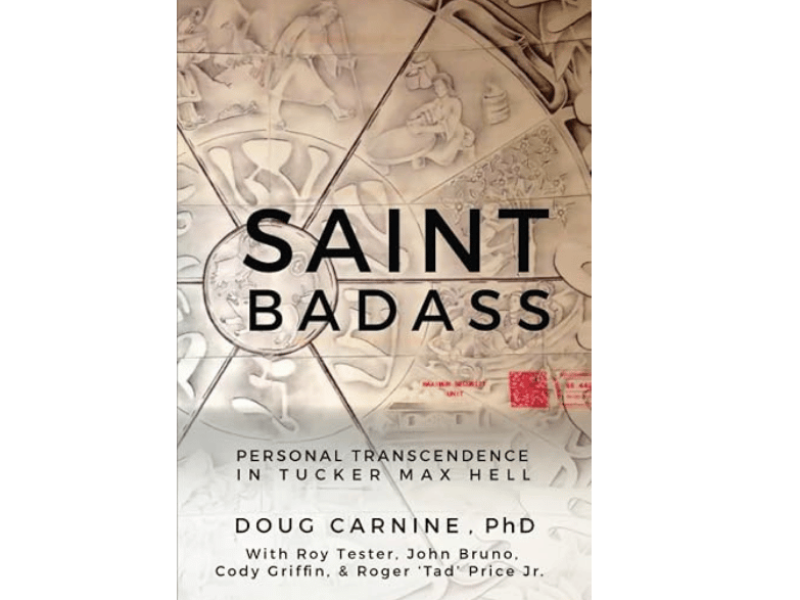
He built the cover art from the only material he could get his hands on: envelopes. Eight of them, to be exact — the same ordinary paper that had carried years of letters back and forth between Arkansas and the outside world, repurposed now as a canvas. Piece by piece, he assembled a single image out of eight separate fragments, working within the strict limits of what a man in his position was allowed to have.
Look closely at the finished piece and you can still see the seams — thin lines running through the image where each envelope meets the next, the fault lines of its construction left visible rather than hidden. In the lower right-hand corner, a U.S. Postal Service postmark survives from one of the original envelopes, an unintentional signature that ties the artwork directly back to the correspondence that produced the book itself. It's not a flaw in the design. It's the evidence of exactly how it was made.
What the Cover Says That the Letters Don't
There's something fitting about a cover made this way for a book like Saint Badass. The memoir's entire premise is that transformation doesn't require ideal conditions — that meditation, kindness, and a change of character are possible even inside a system built to strip away almost everything else. Tester's cover art makes the same argument in a different medium. Denied the tools an artist would normally expect, he didn't produce a lesser version of what he envisioned. He found a way to make the constraint itself part of the piece.
The seams between the envelopes could easily have been sanded down into invisibility in production, smoothed over so the image reads as seamless. Instead, they were left showing. The postmark stayed. The result is a cover that doesn't just illustrate the book's themes — it enacts them. Every visible line is a record of a limitation that got worked around rather than a limitation that won.
A Fitting First Impression
Readers who pick up Saint Badass will spend hundreds of pages with prisoners who found, against long odds, a way to change from the inside out. Before they read a single letter, though, they're already looking at proof of it. The cover isn't a stock illustration or a designer's stand-in for the story — it's a piece made by one of the men the story is actually about, built out of the very paper that carried his words out of Tucker Max Prison and into Doug Carnine's hands.
Eight envelopes and a refusal to accept that "no supplies" meant "no art." It turned out to be enough.
"Well, Bro, I broke those chains.
I'm freer now (life without parole be dammed) than I've ever been."
-Roy Tester, aka Saint Badass, convicted of double homicide.



Related Causes
Reflections by Black Youth on Lasting Happiness for Teens...
After completing our Lasting Happiness: Guide for Teens & Young Adults program, the students and facilitators reflect on what they learned about kindness and the effect it has had on their life.... (Click to Read More)

Spreading Kindness Campaign...
Help us make Eugene and Springfield Cities of Kindness in Oregon... (Click to Read More)

The Book: Saint Badass: Personal Transformation in Tucker Max Hell...
This isn't Doug's story about four men. It's their story, in their own words. Saint Badass was written by Doug and the four men as co-authors — the product of years of correspondence ... (Click to Read More)
Mindful Kindness Program: How Love Wins...
This abbreviated edition of HOW LOVE WINS has been developed by the KINDR Foundation into The Mindful Kindness Program for prisons... (Click to Read More)

Ernesto's Story: Second Chances...
My name is Ernesto Rodriguez. I was a prisoner in California serving a 37-year sentence for crimes I committed at 18 years old. I was incarcerated for 24 years before my release in 2023.... (Click to Read More)

A KINDR Way to Reduce Recidivism...
KINDR Prisons is a program that helps adults in custody to break through self-deprecating thoughts and become catalysts for kindness. Inner transformation is the key to self-forgiveness, the forgi... (Click to Read More)